
The common pattern across domains is not one universal model. Each field retains its own mathematics, sources, limits, and review standards while sharing a more continuous path from scientific question to engineering or operating decision.
Fusion
Fusion teams can connect synchronized shot context, native analysis, evidence, scientific judgment, and the next experiment. The value lies in keeping the investigation coherent as researchers move between observations, models, and candidate next steps.
Space
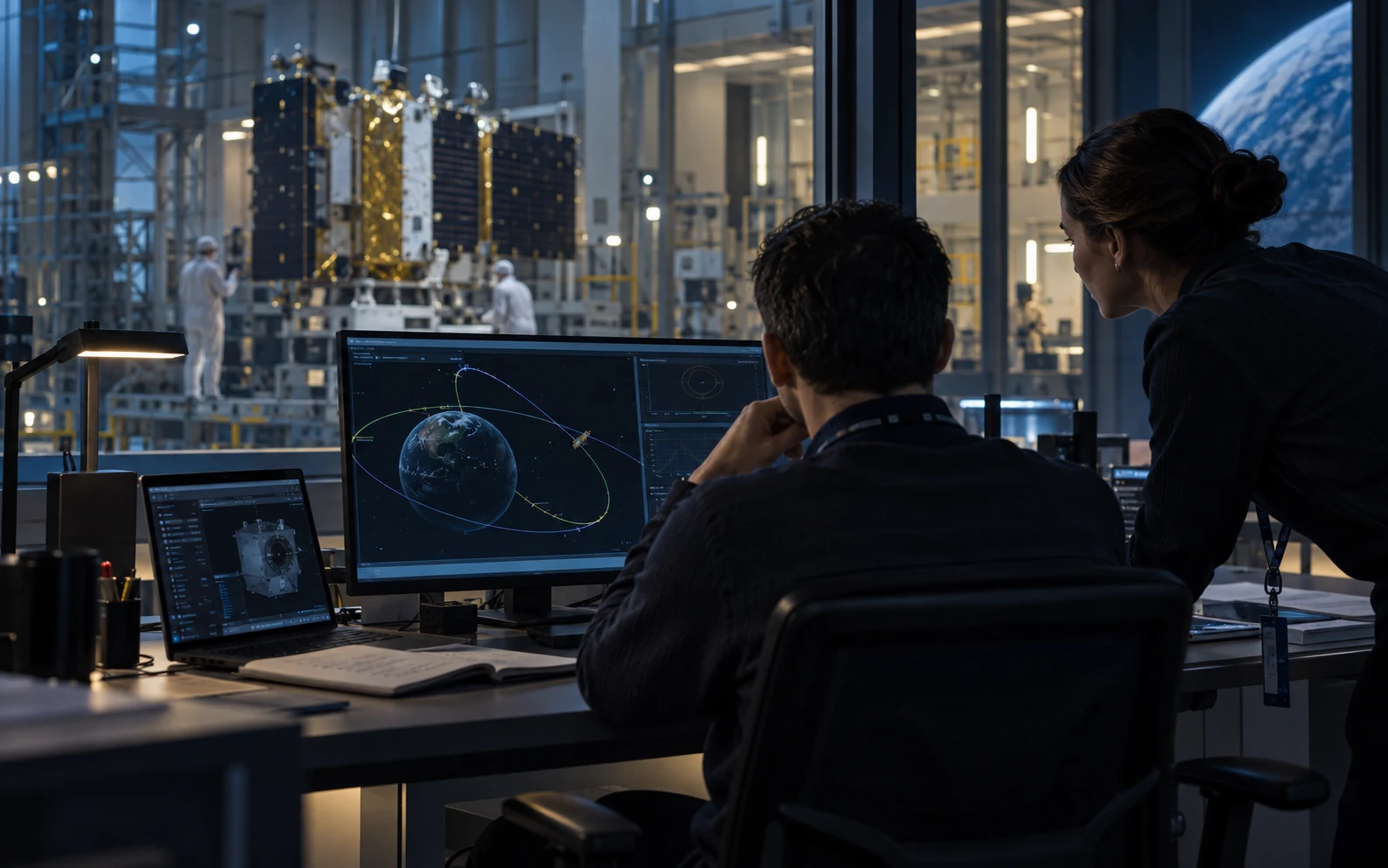
Space applications can compare maneuvers and observation plans against vehicle state, uncertainty, environmental conditions, resource constraints, and mission continuity. Reviewable evidence helps teams understand which assumptions govern a recommendation.
Electromagnetics
Electromagnetic workflows can connect geometry, materials, sources, boundaries, fields, ports, networks, and sensitivities so an engineer can see how a design change affects system behavior.
Materials
Materials applications can connect composition, microstructure, processing history, interfaces, loads, damage, and uncertainty to the engineering response a team needs to evaluate.
Quantum
Quantum workflows can evaluate state, noise, calibration, intervention, uncertainty, and resource constraints while keeping the scientific record connected to productive machine time.
Hypersonics
Hypersonic applications can bring geometry, transport, thermochemistry, wall state, and coupled physical behavior into the study of flow and aerothermal risk.
What remains constant across domains
The methods change by field. The operating principle remains: preserve source context, use the mathematics appropriate to the object, make limits visible, retain reviewable evidence, and connect the result to the next useful decision.